

A hot-reloadable JavaScript and TypeScript runtime for Minecraft servers.
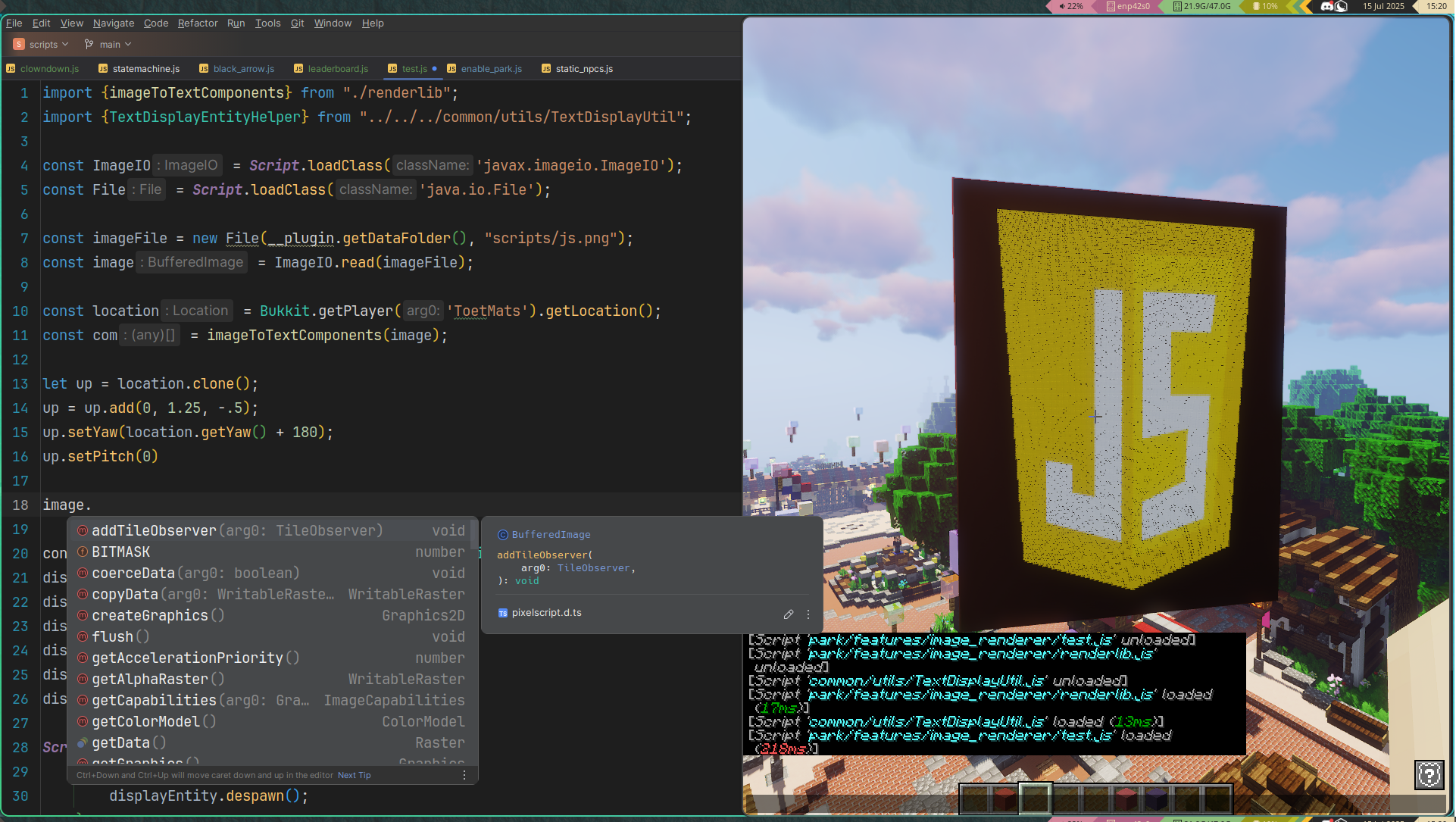
PixelScript runs your server logic as JavaScript on the JVM, calling the real Bukkit/Paper API. Save a file and the change is live. No rebuild, no restart, no reconnect.
You are not learning a scripting language. You are writing Java with JavaScript syntax, against the same API you already know, with the iteration loop of a web app.
registerCommand('heal', (sender, args) => {
  if (!sender.hasPermission('server.heal')) {
    sender.sendRichMessage('<red>No permission.</red>');
    return;
  }

  sender.setHealth(20);
  sender.sendRichMessage('<green>Healed.');
});
That is a complete, working feature. Save the file and /heal exists. Delete the file and it is gone,
unregistered cleanly, with no server restart in either direction.
Start here
New to PixelScript
- Overview, what it is and why
- How to think about a script
- Set up your environment
- Scripts and script management
Using an AI assistant?
Onboard your AI in one command
Coding agents already speak JavaScript. What they need is the runtime: the load tree, the globals, the threading rules. One command drops a condensed reference into your project and the full docs into your workspace.
git clone --depth 1 https://github.com/pixelib/pixelscript-docs .pixelscript-docs \
  && cp .pixelscript-docs/CLAUDE.md ./CLAUDE.md
What you get
Live reload. Edits are detected and applied without restarting. Commands, listeners and scheduled tasks are unregistered and re-registered for you.
A real reload tree. Scripts are root, watched or imported. Watched scripts are barriers, so a change to one feature does not reboot your whole server’s logic. Imported modules are shared singletons that cascade to their importers. You decide where the boundaries are.
The full Bukkit API, plus shortcuts. Bukkit, Scheduler, Sql, Redis, DataFile, registerCommand,
registerListener, fetch and friends are globals. Everything else is one Script.loadClass away, and any
Java library can be pulled in at runtime from a jar or from Maven.
Generated types. Every Java class your scripts touch lands in a generated definitions.d.ts, so your
IDE autocompletes against the exact Bukkit version you are running. Write .ts if you want type checking.
A two-way bridge. Java plugins can hold a type-safe proxy to an implementation written in JavaScript, and it never goes stale across reloads.
Observability. Timings are collected for listeners, commands, tasks, queries and class loads. Read them
in-game with /script info.
The one thing to understand first
Every script is in exactly one of three roles, and the role decides what happens when you hit save:
| Role | Loaded by | On reload of its parent |
|---|---|---|
| Root | Being a .js/.ts file directly in scripts/ |
n/a |
| Watched | Watcher.watch() from a parent |
Does not reload. It is a barrier. |
| Imported | import from another script |
Reloads, and so does everything importing it |
The rule that follows: features get watched, utilities get imported. Features register commands and listeners and export nothing. Utilities export functions and singletons and register nothing. Mixing the two is what produces surprise reload cascades.
Scripts and script management covers this properly.